
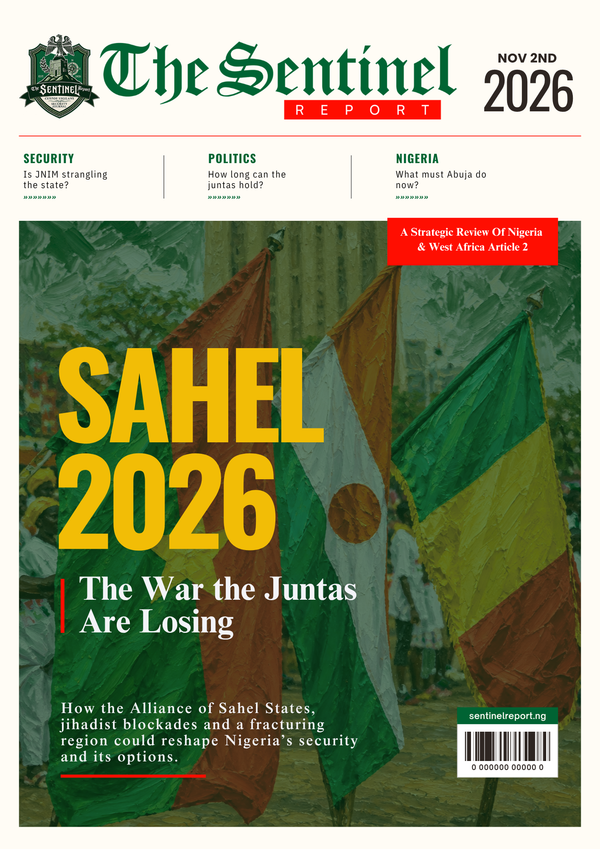
Mali, Burkina Faso and Niger: Security, Political and Economic Assessment, Non-State Armed Groups, and Options for the AU, ECOWAS and Nigeria
The Alliance of Sahel States (AES) · Policy Briefing · October 2026
Assessment by Hon. Aliyu Ibrahim Gebi for the Cyclops Program.
Information current to 28 October 2026. Casualty figures and battlefield claims are frequently unverifiable; they are attributed and should be read as claims unless otherwise stated.
Abbreviations: ACLED (Armed Conflict Location and Event Data); FAMa (Malian Armed Forces); FLA (Front de Libération de l'Azawad); ISSP (Islamic State Sahel Province); ISWAP (Islamic State West Africa Province); JAS (Boko Haram); JNIM (Jama'at Nusrat al-Islam wal-Muslimin); MNJTF (Multinational Joint Task Force); OPSC (Operation Safe Corridor); PSC (AU Peace and Security Council); VDP (Volontaires pour la Défense de la Patrie).
1. Assessment Summary
Bottom line. Three years after its creation and 21 months after leaving ECOWAS, the AES has consolidated politically but is losing the war that justified it. JNIM has moved from rural insurgency to economic strangulation and coordinated attacks on the state's centres of gravity, while ISSP is growing in Niger and north-west Nigeria. The juntas are not close to defeat in their capitals, but their authority outside cities and garrisons is shrinking, their regimes are brittle, and the conflict is spilling into coastal states and Nigeria. The question is no longer whether to engage the AES, but how to do so without legitimising abuses or abandoning democratic norms.
a) Security. ACLED recorded more than 10,000 deaths in the three states in the first 11 months of 2025, and more than 12,000 fatalities involving Islamist groups across the Sahel in the 18 months to August 2026 (ACLED, 2025; ACLED, 2026a). Mali is the decisive theatre: JNIM's fuel blockade of Bamako and the 25 April 2026 JNIM and FLA offensive, which killed Defence Minister Sadio Camara, are the gravest challenge since 2012. Russia's Africa Corps protects regime centres but has not reversed losses; drone campaigns are driving civilian casualties up.
b) Political. All three juntas have converted transitions into open-ended rule and dissolved political parties. Regime security is fragile (purges in Mali, an attempted coup in Niger in August 2026). Alignments are diversifying: Russia remains the main security partner, the United States has pivoted to pragmatic engagement, and Algeria has authorised its first troop deployment abroad since 1973, to northern Niger. A first formal ECOWAS and AES ministerial session in Dakar on 17 October 2026 opened a cooperation track; the AES rules out rejoining (ECOWAS, 2026a).
c) Economic and humanitarian. Resource nationalism (Barrick, Orano, Chinese oil partners) has raised revenue claims but deterred investment. Blockades, border closures and fuel shortages are eroding livelihoods. Nearly 4 million people are displaced, the refugee response was 27 per cent funded, and about 54.8 million people across the wider region faced Crisis-level food insecurity or worse in the 2026 lean season (UNHCR, 2026; CILSS, 2026).
Top-line recommendations. The AU should pair its suspensions with structured engagement through MISAHEL and a dedicated PSC session on civilian protection. ECOWAS should turn the Dakar opening into a time-bound cooperation agreement and field its phased counter-terrorism brigade for frontline coastal states. Nigeria should treat Niger as a strategic partner irrespective of regime type, operationalise a tri-border sector with Benin and Niger, press for Niger's return to the MNJTF, and offer OPSC expertise regionally. All should differentiate: pressure on ISSP, ISWAP and JAS leaderships; discreet, coordinated channels with JNIM and a political track with the FLA; and wider defection pathways everywhere.
2. Detailed Analysis
2.1 Security
Strategic shifts. Three trends matter more than the totals: economic warfare (blockades, attacks on fuel convoys, kidnapping, sabotage); reach into capitals (Kati and Bamako in April 2026, ISSP's assault on Niamey airport in January 2026, a foiled JNIM plot against Niamey's airport and palace in June 2026); and commercial technology at scale, including satellite terminals and drone-guided fire (UN Security Council, 2026; Soufan Center, 2026).
Mali. JNIM announced a fuel blockade in September 2025; more than 300 tankers were reportedly destroyed and schools closed (Bellingcat, 2025). A brief easing in March 2026, reportedly tied to a prisoner release the government denied, ended when JNIM reimposed a total blockade on 28 April (Africanews, 2026a). Bamako is now supplied by escorted convoys (3,441 tankers in October 2026, per Mali's trade directorate) (APA News, 2026): a standing condition rather than a decisive siege. On 25 April JNIM struck Kati, Bamako's airport area, Sévaré, Mopti and Gao while the FLA took Kidal; government and Russian forces withdrew from Kidal, Aguelhok, Tessalit, Tessit, Ber and Léré, several through negotiated exits (Critical Threats, 2026). The UN assesses JNIM's aim was pressure, not overthrow, and that a ransom of about US$50 million paid in 2025 financed the offensive; the UN does not name the payer (UN Security Council, 2026). Africa Corps claims of up to 12,000 attackers and over 1,000 killed are unverified. Attrition followed: at Tabrichat (18 July) at least 19 surrendered soldiers were executed (HRW, 2026); at Dioura (10 September) JNIM claimed 150 soldiers killed, while sources cited by Crisis Group put the toll above 120 (Crisis Group, 2026b). The army re-entered an abandoned, largely destroyed Kidal on 6 October (Soufan Center, 2026).
Burkina Faso and Niger. Burkina Faso has the most territory outside state control: JNIM briefly seized Djibo and Diapaga in 2025, claimed more than 130 attacks in 2026 and is operating closer to Ouagadougou; the VDP auxiliaries are overstretched (ACLED, 2025; UN Security Council, 2026). In Niger, ISSP (Tillabéri, Dosso, Tahoua) dominates; its January 2026 Niamey airport assault destroyed several aircraft, reportedly with ISWAP help, and attacks near Abala and Birni N'Konni in September reportedly killed about 50 personnel (UN Security Council, 2026; Crisis Group, 2026b). A Toubou-led rebellion is active in Agadez. The 28 to 29 August mutiny in Niamey was suppressed with Africa Corps support; Niamey blamed France and neighbours without public evidence (Reuters, 2026c; Crisis Group, 2026b).
Military posture and abuses. The juntas rely on national armies, mass auxiliaries (VDP, Dozo), about 1,000 Africa Corps personnel in Mali (BBC, 2026a) and Turkish TB2 and Akinci drones. ACLED data cited by HRW show 49 Malian and Africa Corps airstrikes killing 89 civilians from April to August 2026, more than double the 2025 period, and Malian forces killing 268 civilians overall against 134 by JNIM; HRW documented strikes on a market and a health centre (HRW, 2026). HRW attributed 1,255 of 1,837 civilian deaths it documented in Burkina Faso (2023 to 2025) to the military and allied militias; the government rejected the report (BBC, 2026b). JNIM's Sharia Committee acknowledged the Tabrichat executions but declined to punish them. The AES Unified Force (about 5,000, launched December 2025, headquartered in Niamey) has conducted joint air strikes but shows little integrated ground manoeuvre (BBC Afrique, 2025).
Spillover. Northern Benin had its deadliest year in 2025 (over 50 soldiers killed in Park W in April); Togo has extended its Savanes emergency; Côte d'Ivoire, Ghana and Senegal serve mainly as transit zones (ACLED, 2025; Crisis Group, 2026a). Attacks in the Niger, Benin and Nigeria border zone rose by 90 per cent from 2024 to 2025 (Reuters, 2026d). For Nigeria, three vectors converge: ISSP's expansion into Kebbi and Zamfara through Lakurawa-linked recruits in the north-west; Ansaru, Mahmuda, JAS factions, JNIM elements and bandits in the Kainji and Borgu forests of the north-central belt (the Woro, Kwara massacre of 3 February 2026 killed more than 160 people); and ISWAP in the Lake Chad basin, where Niger's March 2025 exit from the MNJTF left the Diffa sector uncovered (UN Security Council, 2026; Crisis Group, 2026d; Reuters, 2025d).
2.2 Political
Entrenched juntas. Goïta holds a five-year mandate renewable until Mali is pacified and named himself defence minister after Camara's death; the authorities, alleging soldiers' complicity, launched a wide purge including the abduction of opposition lawyer Mountaga Tall (Reuters, 2026f; The Africa Report, 2026). Tiani's Charter of Refoundation (March 2025) gives him a five-year term (Reuters, 2025a). Burkina Faso dissolved all parties on 29 January 2026 and announced a new constitution in September (Government of Burkina Faso, 2026). Civic space is closing across all three. Popular sovereigntist support is real, but battlefield humiliation, unpaid troops and internal rivalries are the main regime risks.
Institutions and exits. ECOWAS withdrawal took effect on 29 January 2025; ICC withdrawal notifications deposited in June 2026 take effect in June 2027, and the states remain bound until then (UN Treaty Section, 2026). All three remain suspended from the AU. Confederal instruments (unified force, investment bank, 0.5 per cent import levy, passport) exist, but levy revenue and bank lending are undisclosed.
External relations. Relations with France remain hostile, though Mali's August 2026 pardon of a detained French national shows quiet channels. The United States has dropped democracy conditionality, offers intelligence support and is focused on minerals; it also conducted joint operations in Nigeria in 2026, killing senior Islamic State figure Abu Bilal al-Minuki (BBC, 2026a; UN Security Council, 2026). Russia remains the core security partner; the three leaders attend the Russia-Africa Summit on 28 to 29 October 2026. China dominates Niger's oil sector; Turkey supplies drones. Algeria restored ties with Mali in July 2026 (AP, 2026a), deployed Su-30 jets to Niamey after the mutiny, and on 25 to 26 October 2026 authorised troops to northern Niger to protect Sonatrach-linked energy interests; numbers and timing are unannounced (Janes, 2026; AP, 2026b). Morocco's Atlantic Initiative is a long-term option: the Dakhla port is about 74 per cent complete, due end-2028 (Ports Europe, 2026). Ukrainian drone specialists (as reported by CNN) and Libyan brokers add to a crowded field of outside actors.
ECOWAS rapprochement. Under ECOWAS chair Bassirou Diomaye Faye (since 19 July 2026), the Dakar session agreed joint working groups towards a framework cooperation agreement, with no date for the next round (ECOWAS, 2026a; ECOWAS, 2026b). This is the most promising opening since the split.
2.3 Economic and Humanitarian
Mali's dispute with Barrick ended in a November 2025 settlement reported at about US$430 million; production resumed and the Loulo permit was renewed in February 2026 (Barrick, 2025; Reuters, 2026g). High gold prices cushion Mali and Burkina Faso. Niger nationalised Orano's Somaïr mine in June 2025; the uranium dispute is unresolved (Reuters, 2025c; RFI, 2026). Niger's oil lifeline, the pipeline to Benin, is hampered by the closed Benin border and ISSP sabotage, and on 14 October 2026 Niamey gave CNPC-linked firms 45 days to repatriate a claimed US$5.2 billion in revenue (Business Insider Africa, 2026); fuel queues hit Niamey in October. ECOWAS exit costs are accumulating gradually through customs friction, lost project finance and investor caution; continued membership of the CFA franc zone is a stabiliser. OCHA counts 2.8 million internally displaced people (2.1 million in Burkina Faso, a likely undercount) and 11.4 million in need (OCHA, 2026); UNHCR counts more than 818,000 refugees and asylum-seekers (UNHCR, 2026). Aid cuts, including the closure of USAID, have reduced capacity as needs peak.
2.4 Risks and Scenarios, 12 to 24 Months
The most likely scenario is contested muddling through: the juntas survive, JNIM sustains blockade and garrison attacks, and the state holds cities, convoy routes and mines. Regime rupture in Bamako or Ouagadougou through a palace coup or mutiny is plausible and rising (watch purges, unpaid salaries, disappearances of officials). Negotiated de-escalation, most likely in Mali via Algerian, Qatari or religious intermediaries, is possible but partial. Fragmentation, with the fall of a regional capital or collapse of the convoy system, is less likely but very high impact. Regional contagion into Benin, Togo and north-west and north-central Nigeria is already under way. Cross-cutting risks include insurgent exploitation of Nigeria's 16 January 2027 election, further atrocities triggering ethnic reprisals, a major kidnapping or airport attack, a Russian drawdown, collapse of Niger's oil revenue, and a 2027 food shock compounded by aid cuts.
3. Recommendations for the AU, ECOWAS and Nigeria
The guiding principle is pragmatic, conditioned engagement: deal with the AES governments as the de facto authorities; separate security and humanitarian cooperation from the long-term question of constitutional return; and anchor all cooperation in international humanitarian law (IHL), since abuses are the insurgents' best recruiter.
African Union
a) Keep the suspensions but mandate MISAHEL to run a standing AU and AES liaison mechanism with UNOWAS and ECOWAS; suspension without engagement has produced no leverage.
b) Convene a dedicated PSC session on civilian protection in the central Sahel and ask the African Commission on Human and Peoples' Rights to document violations by all parties (HRW, 2026).
c) Offer to guarantee and verify local arrangements (humanitarian corridors, prisoner and hostage exchanges, blockade relief); revive the Nouakchott Process for intelligence and border cooperation; use the AU Peace Fund for humanitarian response and frontline deployments; apply its position on mercenaries to all foreign armed actors; and plan with ECOWAS for sudden regime change or mass displacement.
ECOWAS
a) Turn the Dakar opening into a framework agreement by mid-2027 on free movement, trade and transit corridors, customs and counter-terrorism, keeping governance conditionality in a separate political dialogue; protect AES citizens' free-movement rights meanwhile.
b) Field the phased counter-terrorism brigade of about 1,650 personnel (costed at about US$481.5 million, against US$2.61 billion in year one for a 5,000-strong option), starting with Benin and Togo plus an intelligence fusion cell (ECOWAS, 2025).
c) Build a joint early-warning picture with the AES at the tri-borders; mediate the Benin and Niger rupture (border, pipeline); back police-led, development-heavy prevention in coastal northern regions without stigmatising herders (Crisis Group, 2026a); and apply its democracy protocol consistently to all members.
Nigeria
a) Make Niger a strategic priority irrespective of regime type: a presidential envoy, restored defence and intelligence cooperation, and reopened border trade.
b) Operationalise the tri-border sector with Benin and Niger that the defence minister calls work in progress, with hot-pursuit rules and joint patrols in the Kainji, Borgu, W and Kebbi corridors, before the January 2027 elections (Africanews, 2026b).
c) Press for Niger's return to the MNJTF, as the PSC has urged, with bilateral Diffa coordination in the interim (AU PSC, 2026a); harden the north-west and north-central belts with intelligence on the ISSP, Lakurawa, Mahmuda and JNIM nexus and accountable community policing.
d) Offer a regional Operation Safe Corridor (screening, deradicalisation, reintegration; more than 3,400 reintegrated) with cross-border defector protocols and repatriation of Nigerian fighters (Daily Post, 2026; ADF, 2026); use IPCR, the Office of the National Security Adviser and Islamic scholarly networks for Track 1.5 mediation and to bridge ECOWAS and the AES.
e) Use economic levers (formal fuel supply to Niger, Trans-Saharan corridors, easing the pipeline dispute); back the ECOWAS brigade for frontline support, not intervention; and ensure partner strikes on Nigerian soil are jointly planned and civilian-harm-mitigated.
Table 1. Recommendations matrix
| Area | African Union | ECOWAS | Nigeria |
|---|---|---|---|
| Political | MISAHEL liaison; keep suspension but engage | Framework agreement by mid-2027 | Presidential envoy to Niamey |
| Security | Nouakchott Process; intelligence platform | Phased 1,650 CT brigade; joint early warning | Tri-border sector; Niger back into MNJTF |
| Civilians and IHL | Dedicated PSC session; ACHPR documentation | IHL conditions on shared intelligence | Civilian-harm mitigation; accountable community policing |
| Dialogue and DDR | Guarantor of local deals and exchanges | Regional coordination of local deals | Regional OPSC offer; Track 1.5 mediation |
| Economy | Peace Fund and partner financing | Protect corridors and free movement | Formal fuel supply; border markets; corridors |
| Timing | PSC session in 3 months; liaison in 6 | Working groups in 3 months | Envoy now; tri-border sector before Jan 2027 |
4. Non-State Armed Groups
The landscape spans al-Qaeda and Islamic State affiliates and splinters, separatists, state-aligned militias and criminal networks, with fighters, weapons and money moving between them. Strength estimates are uncertain and attributed.
JNIM (al-Qaeda, formed 2017 from Ansar Dine, AQIM's Sahara branch, al-Mourabitoun and Katiba Macina). Led by Iyad Ag Ghaly, a Tuareg from Kidal whose tribal ties underpin the FLA alliance, with Amadou Kouffa (Katiba Macina) second; about ten regional commands, eight in Mali (Crisis Group, 2026a). The UN estimates that there are 7,000 to 8,000 members, about half in Mali (UN Security Council, 2026). Active across Mali, Burkina Faso, south-western Niger, northern Benin and Togo, and announcing a presence near Kainji in Nigeria. Tactics: blockades, garrison assaults, vehicle bombs, drone-guided fire, kidnapping. Revenue: zakat, gold, ransoms, smuggling levies. It governs through rough Sharia justice and local non-aggression pacts and recruits mainly on Fulani grievances, but across ethnic groups. It fights ISSP (ISSP claims of hundreds killed in 2026 clashes are unverified). Trajectory: ascendant, pursuing attrition to force negotiation on its terms.
ISSP (Islamic State; founded 2015 by Adnan Abu Walid al-Sahrawi, killed 2021; a separate province since 2022). About 2,000 fighters per the UN, with Niger accounting for about 75 per cent of its attacks; expanding into Sokoto, Kebbi and Zamfara through Lakurawa-linked recruits (UN Security Council, 2026). More coercive than JNIM: massacres, convoy ambushes, pipeline attacks, extortion. Some analysts describe a tacit truce with juntas focused on JNIM (Soufan Center, 2026). Trajectory: the group most likely to build a durable Niger and Nigeria sanctuary.
ISWAP (split from Boko Haram 2016). Lake Chad basin, Borno, Yobe, Diffa. Strength estimates vary widely; the UN recorded more than 174 attacks from January to May 2026 and about 35 commercial drones (UN Security Council, 2026). Overruns bases, taxes fishing, farming and trade, and runs the region's most developed proto-state governance. Resilient and supporting ISSP.
JAS (Boko Haram) factions. Led since Shekau's 2021 death by Bakura Doro from the Lake Chad islands, alongside smaller factions (Sadiku, Darul Gazwa, Ali Ngulde) (The New Humanitarian, 2026). Violence surged early in 2026 (more than 416 abducted at Ngoshe) and has declined unevenly since April (ACLED, 2026b). One UN member state attributes the Woro massacre to Sadiku elements (UN Security Council, 2026). The New Humanitarian reported a secret ceasefire with Bakura Doro since June 2026, following hostage releases; officials and a faction representative denied it, and the report should be treated as unconfirmed.
Ansaru, Mahmuda and Lakurawa. Ansaru (al-Qaeda aligned, 2012) works with bandits in Kaduna, Niger and Kwara and could bridge JNIM into Nigeria; Nigeria announced the capture of its top two leaders in 2025 (Office of the National Security Adviser, 2025). Mahmuda operates around Kainji Lake National Park; its affiliation is contested. Lakurawa, invited around 2017 to 2018 to protect Sokoto and Kebbi communities from bandits, turned to imposing levies and Sharia rulings, was proscribed in January 2025 and is being absorbed by ISSP.
FLA (Tuareg and Arab separatists, merged late 2024 after Mali ended the Algiers Agreement). Defeated Wagner at Tinzaouaten in 2024 and allied with JNIM in April 2026; released 82 soldiers in August 2026 and denies involvement in the Tabrichat executions (Crisis Group, 2026c; HRW, 2026). Squeezed by drones but an indispensable political interlocutor for northern Mali.
State-aligned militias. Burkina Faso's VDP and Mali's Dozo and Dan Na Ambassagou militias are implicated with armies in killings of Fulani civilians; JNIM has forced many Dozo groups to disarm (ACLED, 2025; HRW, 2026). Nigerian vigilantes are vital for intelligence but face abuse allegations.
Bandits and smuggling. North-west Nigerian bandit groups (estimates run to tens of thousands across well over 100 groups, but are imprecise) run kidnap and protection economies; leaders such as Bello Turji remain at large (Sahara Reporters, 2026). Fuel, gold, weapons, motorcycles, cattle, drugs and migrants move along routes armed groups tax; artisanal gold is the largest single armed-group revenue source in Mali and Burkina Faso.
Table 2. Armed groups at a glance and recommended approach
| Group | Affiliation and areas | Strength (attributed) | Revenue | Trajectory | Recommended approach |
|---|---|---|---|---|---|
| JNIM | Al-Qaeda; Mali, Burkina, SW Niger, N Benin and Togo, Kainji | 7,000 to 8,000 (UN) | Zakat, gold, ransoms, levies | Ascendant | Containment plus negotiation: protect corridors, coordinate local deals, exchanges, cut ransoms and gold revenue |
| ISSP | Islamic State; Ménaka, Tillabéri, Tahoua, Dosso, NW Nigeria | c. 2,000 (UN) | Extortion, cattle, kidnapping | Growing | Sustained pressure; joint Niger and Nigeria operations; defections |
| ISWAP | Islamic State; Lake Chad basin | Several thousand (estimates vary) | Taxing fishing, farming, trade | Resilient | Pressure; restore MNJTF coverage; counter-drone; defections |
| JAS factions | Independent; Lake Chad islands, Mandara, moving south-west | Not reliably estimated | Kidnapping, raiding | Fragmented | Pressure; exploit splits; OPSC intake; any truce transparent |
| Ansaru, Mahmuda, Lakurawa | AQ-aligned, contested, ISSP-linked; NW and north-central Nigeria | Hundreds | Kidnapping, levies | Bridges for JNIM and ISSP | Targeted operations; cut links; protect forest communities |
| FLA | Separatist; Kidal, Gao, Timbuktu | Not reliably estimated | Trade levies, external support | Under pressure | Algeria-facilitated, AU-backed political process |
| VDP, Dozo, vigilantes | State-aligned; Burkina, central Mali, Nigeria | VDP tens of thousands (govt) | State payments | Overstretched, abusive | Command integration, codes of conduct, prosecutions |
| NW bandits | Criminal; Zamfara, Katsina, Sokoto, Kebbi, Kaduna, Niger | Tens of thousands (imprecise) | Ransoms, levies, gold | Converging with jihadists | Enforcement plus dialogue conditioned on verified disarmament |
5. Confronting the Armed Groups
A decade of militarised responses has not reversed the jihadist expansion. Military pressure is necessary but insufficient and, when abusive, counterproductive. Eight lines of effort should be combined and differentiated by group (Table 2).
a) Military and security. Protect populations, roads and markets rather than clear ground that cannot be held; invest in intelligence, mobility and precision air power under strict targeting rules; pay, rotate and professionalise troops; bring auxiliaries under command and law; deploy counter-drone systems and regulate satellite terminal and drone imports.
b) Governance. Restore basic justice, registration, health and schooling in contested areas through local administrators and customary authorities; address land and pastoral conflicts behind Fulani grievances; reopen civic space.
c) Dialogue. Local deals with JNIM are already widespread; they save lives but, without state backing, regional coordination and monitoring, they entrench insurgent governance and collapse easily, as the March 2026 blockade easing showed (Crisis Group, 2026a). Support discreet channels with JNIM (religious scholars, the Malian High Islamic Council, Algeria or Qatar) with limited aims: blockade relief, exchanges, humanitarian access, protection of schools and clinics. Pursue a political process with the FLA. Do not negotiate politically with ISSP, ISWAP or JAS leaderships; any tactical arrangements must be transparent and tied to hostage release. Condition dialogue with bandits on verified disarmament, unlike the failed Zamfara and Katsina amnesties.
d) Defection and DDR. Nigerian officials report more than 300,000 surrenders, fighters and dependants, since 2016 (ThisDay, 2026); OPSC graduated 744 in April 2026 (Daily Post, 2026). Lessons: a credible, legally clear surrender pathway; rigorous screening separating low-risk members from perpetrators of serious crimes; community acceptance and victim support; separate tracks for women and children; follow-up; and cross-border protocols. Factional crises, such as after Shekau's death, open defection windows. AES states have no comparable programmes.
e) IHL and civilian protection. Condition intelligence and equipment on IHL compliance; support investigations of incidents such as Djibo, Tombonkore and Talahandak; engage the ICRC and Islamic law scholars on the convergence of IHL and the Islamic law of war, including treatment of prisoners; protect humanitarian access.
f) Counter-financing. A regional commitment against ransom payments (the 2025 ransom financed the 2026 offensive); gold traceability with refining hubs in the UAE and Switzerland; targeting fuel, cattle and motorcycle smuggling while protecting civilian border economies.
g) Border and regional cooperation. Joint patrols and hot-pursuit at the tri-borders, building on the August 2026 Ghana and Burkina Faso corridor-escort pact; regional coordination of local deals so violence is not displaced; sharing data on foreign fighters and weapons, including Sudanese-made rifles found with ISWAP (UN Security Council, 2026).
h) Counter-narrative and development. Mobilise credible scholars, Sufi orders and traditional rulers (including the Sultanate of Sokoto) against takfir and the killing of Muslims; amplify defectors' and victims' voices without stigmatising the Fulani; target youth jobs, pastoral livelihoods, land tenure and schooling.
6. Conclusion
The AES has achieved its political project of sovereignty and regime consolidation but is failing its central security promise. JNIM is waging a war of strangulation that the juntas and Russia can contain in the capitals but not reverse in the countryside, while ISSP and its Nigerian connections build a cross-border base that directly threatens Nigeria. Collapse within two years is unlikely; regime ruptures, atrocities and contagion are realistic. The choice for the AU, ECOWAS and Nigeria is not between isolation and endorsement but a durable working relationship focused on shared threats, civilian protection and economic interdependence, while holding to principles consistently. The Dakar process, Algeria's re-engagement, Washington's pragmatism and Nigeria's experience of dialogue and reintegration create a window; if it is not used, the armed groups will fill the vacuum.
References
- ACLED (2025) Nsaibia, H. [Sahel year-end conflict analysis, 1 January to 28 November 2025]. 11 December. acleddata.com
- ACLED (2026a) Bofin, P. [Islamist violence in the Sahel and West Africa, August 2026 update]. 14 August. acleddata.com
- ACLED (2026b) Serwat, L. [JAS violence in the Lake Chad basin, 2026]. 16 September. acleddata.com
- ADF (2026) 'Operation Safe Corridor "keeps the door open" to surrender'. Africa Defense Forum, August.
- Africanews (2026a) [Reported JNIM truce and prisoner release in Mali; government denial]. March.
- Africanews (2026b) [Nigeria's defence minister on a tri-border sector with Benin and Niger]. 3 July.
- AP (2026a) 'Mali and Algeria reopen airspace and reinstate ambassadors, ending a yearlong rift'. July.
- AP (2026b) 'Algeria to send troops to Niger in first foreign deployment in over 50 years'. October.
- APA News (2026) [Mali: tanker convoys escorted into Bamako, October 2026]. 26 October.
- AU PSC (2026a) [Communiqué urging Niger's return to the MNJTF]. 18 May. peaceau.org
- Barrick (2025) [Barrick and Government of Mali settlement on Loulo-Gounkoto]. Press release, November.
- BBC (2026a) Melly, P. [US policy shift towards the Sahel juntas; Africa Corps in Mali]. 2 February.
- BBC (2026b) [HRW report on civilian killings in Burkina Faso]. 6 April.
- BBC Afrique (2025) 'Force unifiée de l'AES : comment pourrait-elle atteindre ses objectifs ?'. December.
- Bellingcat (2025) [JNIM's fuel blockade and attacks on tanker convoys in Mali]. 3 December.
- Business Insider Africa (2026) [Niger's 45-day ultimatum to Chinese oil partners]. 15 October.
- CILSS (2026) Cadre Harmonisé, projected situation June to August 2026.
- Crisis Group (2026a) Report No. 321 [JNIM's expansion, structure and options]. 20 February.
- Crisis Group (2026b) CrisisWatch, September 2026. crisisgroup.org/crisiswatch
- Crisis Group (2026c) CrisisWatch, August 2026. crisisgroup.org/crisiswatch
- Crisis Group (2026d) Obasi, N. 'Massacre in Kwara State heightens Nigeria's security challenges'. February.
- Critical Threats (2026) 'Fall of Kidal: what JNIM's latest offensive means for Mali's future'. AEI, April.
- Daily Post (2026) 'FG graduates 744 repentant terrorists under Safe Corridor programme'. 16 April.
- ECOWAS (2025) [Standby Force counter-terrorism brigade: costed options]. 1 September.
- ECOWAS (2026a) [Communiqué of the ECOWAS and AES ministerial session, Dakar]. 17 October.
- ECOWAS (2026b) 'Key decisions of the 69th ECOWAS Summit', Freetown. 19 July.
- Government of Burkina Faso (2026) 'Synthèse du Conseil des ministres du 29 janvier 2026'. gouvernement.gov.bf
- HRW (2026) [Mali: drone strikes and abuses by all parties, April to August 2026]. Human Rights Watch, 19 October.
- Janes (2026) 'Algeria deploys fighter jets to Niamey'. August/September.
- OCHA (2026) [Central Sahel humanitarian snapshot]. 29 June.
- Office of the National Security Adviser (2025) [Capture of Ansaru leaders Mahmud Usman and Mahmud al-Nigeri]. August.
- Ports Europe (2026) 'Dakhla Atlantic port works 74% complete, with delivery still set for end-2028'. October.
- Reuters (2025a) [Niger charter grants Tiani five-year transition]. 26 March.
- Reuters (2025c) [Niger nationalises Orano's Somaïr uranium mine]. June.
- Reuters (2025d) 'Niger withdraws from Lake Chad military force'. 30 March.
- Reuters (2026c) 'Niger, with Russia's help, regains control of key airbase after soldiers mutiny'. 30 August.
- Reuters (2026d) [Jihadist attacks in the Niger, Benin and Nigeria border zone up 90 per cent]. 26 February.
- Reuters (2026f) 'Mali investigates soldiers over role in coordinated insurgent attacks'. 2 May.
- Reuters (2026g) [Mali renews Barrick's Loulo permit]. 13 February.
- RFI (2026) 'Niger : le général Tiani ouvre la porte à une restitution de l'uranium à Orano'. 15 February.
- Sahara Reporters (2026) [Bello Turji imposes levies in Sokoto State]. 8 October.
- Soufan Center (2026) Nasr, W. [IntelBrief: Mali after the recapture of Kidal]. 28 October.
- The Africa Report (2026) 'Mali junta launches wide-ranging purge following allegations of military complicity'. May.
- The New Humanitarian (2026) Anyadike, O. [Secret ceasefire with Boko Haram's JAS faction]. 7 September.
- ThisDay (2026) 'DHQ: 300,000 terrorists surrendered, 2,615 reformed, reintegrated in nine years'. 4 April.
- UN Security Council (2026) 38th report of the ISIL and Al-Qaida Monitoring Team, S/2026/651. 10 August.
- UN Treaty Section (2026) Depositary notifications C.N.251, 263 and 264.2026 (Rome Statute withdrawals). June.
- UNHCR (2026) [Central Sahel displacement and funding update]. 9 October.