
By Hon. Aliyu Ibrahim Gebi
1. The US–Cameroon BIR Deal: Implications for Nigeria and Regional Security
The transaction exchanging $35 million in U.S. military assistance (including armored personnel carriers) to Cameroon's Bataillon d'Intervention Rapide (BIR) for Cameroon's agreement to take deportees from the United States represents a significant shift in regional security dynamics.
This deal carries major strategic implications for Nigeria's counter-insurgency operations, regional cross-border crime, and the ongoing Ambazonia separatist conflict in Cameroon.
Implications for Nigeria and Regional Anti-Terrorism Operations
a) Strengthened Lake Chad / North-East Security Axis: The BIR’s elite Operation Alpha is a main pillar in counter-terrorism operations against Boko Haram and ISWAP in the Far North Region of Cameroon. Infusing $35 million in military kit (like armored personnel carriers) bolsters the BIR’s offensive capability along the porous Far North border with Borno State. This directly relieves pressure on the Nigerian Military (MNJTF) by choking off insurgent escape routes, logistical supply lines, and hideouts around Lake Chad and the Mandara Mountains.
b) Mitigation of Cross-Border Crime: Porous borders facilitate the illegal flow of small arms, light weapons (SALW), and fuel smuggling between Northern Cameroon and Nigeria. Upgrading the BIR’s mobility and equipment allows for more aggressive border interdiction, restricting transnational criminal networks that fuel banditry in Nigeria’s northern regions.
c) Potential Border Re-displacement: A heavily funded BIR offensive in Northern Cameroon risks forcing insurgents, bandits, and transnational syndicates to flee west across the porous borders into Adamawa, Borno, and Taraba states, shifting the immediate tactical burden back onto Nigerian border patrols.
Implications for the Ambazonia Rebellion (Anglophone Crisis)
a) Resource Fungibility and Reallocation: Although the deal explicitly targets operations in Northern Cameroon, military hardware and elite units are fungible. By subsidizing the BIR’s counter-terrorism mission in the North, the Cameroonian government can free up internal state funds and redeploy non-BIR military units to the Northwest and Southwest regions—the epicenter of the Ambazonia movement.
b) Lifting Human Rights Restrictions: Previous U.S. policy restricted military aid to Cameroon under Leahy Law provisions due to human rights abuses attributed to the BIR in Anglophone regions. Resuming aid—even for counter-deportation favors—signals a weakening of Western human rights oversight, potentially emboldening Cameroonian forces toward harsher crackdowns in Ambazonian strongholds.
c) Asymmetric Escalation in Southern Cameroons: Ambazonian separatists are likely to perceive this deal as direct U.S. alignment with Yaoundé. This could trigger heightened guerrilla tactics, broader attacks on infrastructure, and deeper collaboration between Ambazonian factions and Nigerian separatist groups (such as IPOB/ESN) along the southeastern border.
Summary Perspective
The deal prioritizes transactional immigration enforcement and operational counter-terrorism over regional governance concerns. While it strengthens the military buffer for Nigeria's northeast against Boko Haram/ISWAP, it simultaneously risks hardening the Anglophone crisis and creating secondary displacement issues along Nigeria's eastern borderlands.
2. The Algeria–Niger Military Deployment Agreement: A Broader Regional Security Realignment
Connecting the US–Cameroon BIR deal to the Algeria–Niger military deployment agreement reveals how regional security in Central and West Africa is splitting into two distinct strategic axes:
a) The US–Cameroon Bilateral Model: Transactional, bilateral security assistance driven by Western priorities (immigration enforcement, immediate counter-terrorism containment).
b) The Sovereign Security Realignment in the Sahel: Non-Western, energy-and-infrastructure-focused force deployments following the collapse of ECOWAS/French security umbrellas.
Macro-Strategic Implications for Nigeria
a) Strategic Compression (Squeeze Effect on Borders):
i. The Eastern Flank (Cameroon): Enhanced US support for Cameroon’s BIR strengthens containment around the Mandara Mountains and Lake Chad Basin.
ii. The Northern Flank (Niger): Algerian troops deployed into Niger—specifically targeting security along the shared northern border and energy assets like Sonatrach's oil blocks and the Trans-Saharan Gas Pipeline (TSGP)—create a heavily fortified northern boundary.
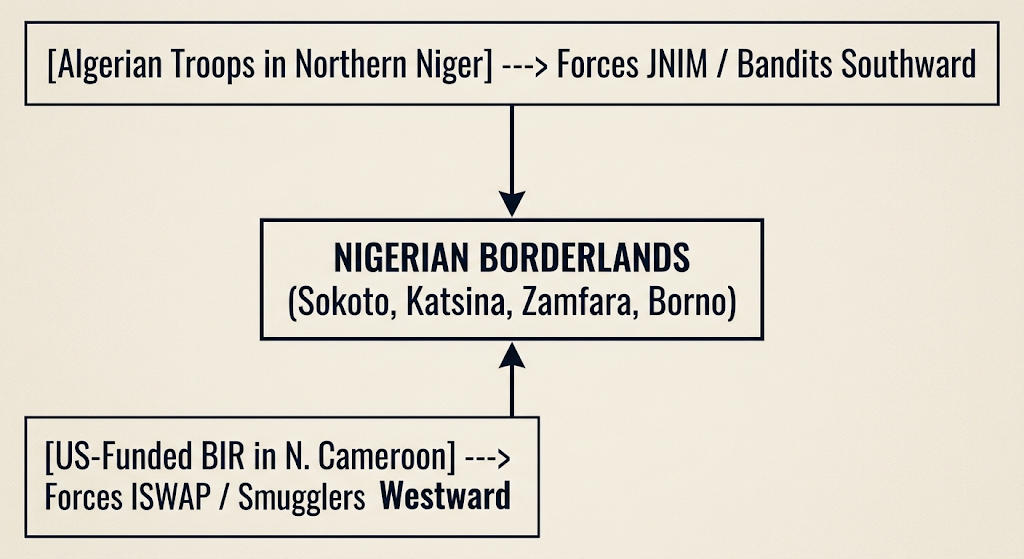
iii. The Result: Insurgent groups (ISWAP, JNIM) and armed bandit syndicates face increased pressure from both the northeast (Cameroon) and the north (Algeria–Niger). This risks displacing armed groups directly into Nigeria’s domestic operational zones (the Northwest and North-Central regions), where border enforcement remains overstretched.
b) Re-energizing Critical Infrastructure (The TSGP Advantage):
i. The Algeria-Niger agreement explicitly protects shared economic and energy infrastructure—most notably the multi-billion dollar Trans-Saharan Gas Pipeline (TSGP) connecting Nigeria to Algeria via Niger.
ii. Securing this corridor with Algerian military power addresses a key vulnerability that previously stalled Nigerian energy export diversification.
c) Fragmentation of Regional Security Coalitions:
i. Nigeria traditionally relied on multilateral frameworks like ECOWAS and the Multinational Joint Task Force (MNJTF).
ii. The emergence of bilateral foreign troop deployments in neighboring states (Algeria in Niger; US-backed BIR in Cameroon) signals a breakdown in unified regional security architectures, forcing Nigeria to navigate ad-hoc bilateral relationships rather than cohesive bloc actions.
Impact on Insurgency, Banditry, and Cross-Border Crime
a) Banditry and Transnational Arms Flows:
i. Algeria’s troop deployment stabilizes northern Niger and deters large-scale trans-Saharan arms smuggling corridors from Libya.
ii. However, as Algerian forces establish fixed defensive positions around energy installations, non-state armed actors may divert their supply routes toward weaker, unmonitored border sections connecting Niger to Sokoto, Katsina, and Zamfara states in Nigeria.
b) Containment vs. Displacement of Terror Groups:
i. While the BIR pressures Boko Haram/ISWAP on the Cameroonian side of Lake Chad, Algerian presence in Niger restricts terror movement northward.
ii. This creates a tightening "pincer," forcing militant factions to either fight for survival inside Nigerian territory or adapt into hybrid criminal-bandit alliances within Nigeria's middle belt.
Implications for the Ambazonia Rebellion in Cameroon
a) Reallocation of State Resources to the South:
i. Just as US aid to the BIR allows Yaoundé to free up internal military spending for operations against Anglophone separatists, Algeria's military footprint in Niger stabilizes Cameroon’s northwestern exterior along the Sahelian corridor.
ii. With external regional threats in the Sahel being managed by heavyweights like Algeria and US-backed units, Cameroon can further concentrate its elite forces and domestic budget toward suppressing the Ambazonian insurgents in its Northwest and Southwest regions.
b) Strengthened Inter-State Counter-Separatist Alignment:
i. Algeria’s historic emphasis on state sovereignty and opposition to border realignments reinforces a regional status-quo bias across North and West Africa.
ii. This broader geopolitical trend toward hard sovereignty discourages international recognition or intervention on behalf of Ambazonian separatists, isolating the movement further on the international stage.
Key Takeaway
Both agreements mark a transition toward transactional, state-centric security interventions. While they provide targeted relief against terrorism and secure major economic projects like the Trans-Saharan Gas Pipeline, they risk creating a "balloon effect"—squeezing security crises out of Niger and Northern Cameroon directly into Nigeria's under-policed hinterlands and intensifying state pressure on the Ambazonian conflict in Southern Cameroon.
3. Compound Implications for West Africa and the Sahel
Expanding the geopolitical lens to include ongoing conflicts in Sudan, the Central African Republic (CAR), Ethiopia, and Eritrea reveals that West Africa and the Sahel do not exist in isolation. Instead, they form the western end of an interconnected Trans-African Instability Belt stretching from the Red Sea to the Atlantic Ocean.
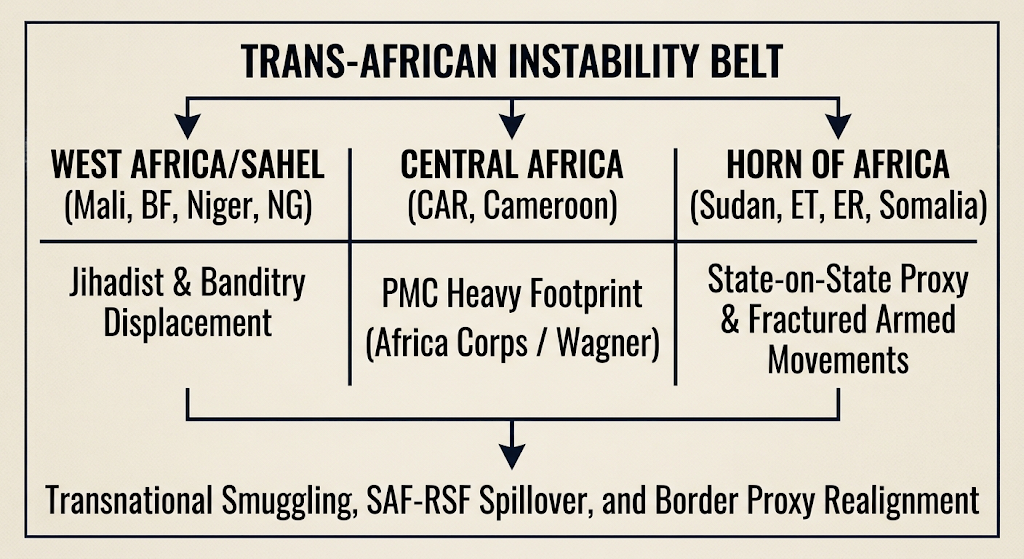
Trans-African Instability Belt
West Africa/Sahel (Mali, Burkina Faso, Niger, Nigeria) · Central Africa (CAR, Cameroon) · Horn of Africa (Sudan, Ethiopia, Eritrea, Somalia)
a) West Africa/Sahel: Jihadist and banditry displacement.
b) Central Africa: Heavy private military company (PMC) footprint, including Africa Corps/Wagner.
c) Horn of Africa: State-on-state proxy conflict and fractured armed movements.
These dynamics converge through transnational smuggling, Sudanese Armed Forces–Rapid Support Forces (SAF–RSF) spillover, and border proxy realignment.
Transnational Arms and Fighter Highways
a) The Sudan–CAR–Chad Connection: Sudan’s civil war (SAF vs. RSF) and CAR’s ongoing proxy conflicts have created an unchecked illicit arms bazaar across Darfur, northern CAR, and eastern Chad. Weapons (including ATGM systems, UAV kits, and heavy machine guns) flow through CAR and Chad directly into northern Cameroon and northeastern Nigeria (Lake Chad Basin).
b) Fighter Mobility: Displaced mercenaries and combatants cross seamlessly between the Sudanese/CAR theaters into the Lake Chad Basin and Sahelian corridors, reinforcing Boko Haram/ISWAP factions and Sahelian jihadist syndicates (JNIM).
Strategic Compression of Nigeria and Regional Powers
a) Cross-Regional Encirclement: With Algeria deploying troops to northern Niger to protect pipeline infrastructure, US-funded BIR operations in Northern Cameroon, and heavy Russian/PMC footprints in CAR, Nigeria is surrounded by highly militarized, foreign-backed zones.
b) Refugee and Criminal Displacement: As conflicts in Sudan and CAR worsen, human trafficking networks merge with Sahelian arms syndicates, putting extreme pressure on border infrastructure in eastern Nigeria (Taraba, Adamawa, Borno states).
Geopolitical Proxy Realignment
a) Red Sea to Sahel Power Dynamics: Rivalries playing out in Sudan and Ethiopia (involving the UAE, Russia, Turkey, and regional Arab powers) spill into West Africa. Countries in the Sahel (AES bloc: Mali, Burkina Faso, Niger) leverage Russian PMC support, while neighbors like Cameroon and Chad balance U.S. counter-deportation/counter-terror deals against UAE/Russian intelligence operations.
4. Conflict Parties and Private Military Companies (PMCs)
A. Key State and Non-State Conflict Parties
| Country / Conflict Zone | Party / Faction Name | Primary Area of Operation (AOR) | Dominant Assets and Technical Inventory |
|---|---|---|---|
| Sudan | Sudanese Armed Forces (SAF) | Khartoum, River Nile, Red Sea State, parts of Kordofan | Su-25/MiG-29 jets, Mi-24/35 helicopter gunships, T-55/T-72 main battle tanks (MBTs), heavy artillery (122mm/152mm). |
| Sudan | Rapid Support Forces (RSF) | Darfur (El Fasher, Nyala), Khartoum, West Kordofan | Technicals (12.7mm/14.5mm/DShK mounted pickup trucks), MANPADS, FPV/commercial strike drones, light armored vehicles. |
| CAR | FACA (Central African Armed Forces) | Bangui, West and East Prefectures, Vakaga | BTR-80 APCs, Ural/KamAZ transport, light infantry arms, drone surveillance. |
| CAR | CPC (Coalition of Patriots for Change) | Northern/Western CAR, border regions with Chad/Sudan | Technicals, RPG-7s, small arms/light weapons (SALW), improvised explosive devices (IEDs). |
| Ethiopia | ENDF (Ethiopian National Defence Force) | Amhara, Oromia, Tigray borders, Afar | Bayraktar TB2/Wing Loong II UAVs, Su-30 fighters, T-72/80 MBTs, Type 81 multiple-launch rocket systems (MLRS), heavy artillery. |
| Ethiopia | Fano Militias / TPLF Factions | Amhara Region/Tigray borders | Captured ENDF weapons, mortars, technicals, light arms. |
| Eritrea | EDF (Eritrean Defence Forces) | Southern border (Tigray borderlands), Red Sea Coast | T-55/62 MBTs, BM-21 Grad MLRS, ZU-23-2 anti-aircraft systems, heavy infantry armaments. |
B. Active PMCs and Foreign Military Contractors
| PMC / Unit Name | Sponsoring / Origin State | Deployed Strength (Estimate) | Technical Inventory and Capabilities | Primary Area of Operation (AOR) |
|---|---|---|---|---|
| Africa Corps (formerly Wagner Group) | Russia | 2,000–2,500 (CAR); 1,500–2,000 (Sudan/border); 1,000–1,500 (Mali/Niger) | L-39 Albatros strike jets, Mi-8/Mi-24 helicopters, Tiger/BTR-80 APCs, electronic warfare (EW) jamming suites, drone reconnaissance. | CAR: Bangui, Bria, Birao (Sudan border). Sudan/Chad border: Logistics hubs for RSF. Sahel: Central Mali, Tillabéri (Niger). |
| SAD / Corp-Sevita (FACA Auxiliaries) | Russia | 300–500 | Light tactical vehicles, thermal optics, tactical drone surveillance, VIP protection assets. | CAR: Operational security in Bangui, tactical training camps. |
| LANA / Private Security Groups (Emirati-linked networks) | UAE (logistics/contractors) | Undisclosed (contractor and logistics networks) | Air logistical transport, tactical drone supply networks, satellite communications equipment. | Sudan/Chad border: Amdjarass Airfield (supply hub for Darfur/RSF), eastern Sudan border routes. |
| Sadat International Defense Consultancy (historical and advisory) | Turkey | Advisory / low | Bayraktar TB2 integration hardware, electronic surveillance ground stations, tactical training simulators. | Ethiopia/Sudan; technical advisory and drone operation centres supporting state armed forces. |
5. Overall Strategic Implications for Nigeria
The US–Cameroon BIR deal, the Algeria–Niger military deployment agreement, and the broader Trans-African Instability Belt reveal interconnected regional security dynamics extending from the Lake Chad Basin and the Sahel to Central Africa and the Horn of Africa.
The US–Cameroon arrangement reflects transactional, bilateral security assistance driven by immigration enforcement and immediate counter-terrorism priorities. The Algeria–Niger deployment reflects a sovereign security realignment focused on territorial security and critical energy infrastructure. Meanwhile, the conflicts in Sudan, CAR, Ethiopia, and Eritrea add a wider dimension involving arms flows, fighter mobility, foreign military contractors, proxy competition, and displacement across regional borders.
For Nigeria, these developments present a combination of potential security benefits and significant risks. Increased pressure on armed groups in northern Cameroon and Niger could improve containment around neighbouring territories, while the protection of major energy infrastructure could support regional economic ambitions. However, these measures also risk redirecting armed groups, trafficking networks, and illicit supply chains towards less protected areas of Nigeria.
At the same time, the use of bilateral security arrangements and foreign-backed military deployments raises questions about the future of multilateral security cooperation, the protection of civilians, and the management of the Ambazonia conflict in Cameroon.
The central concern is that security pressure in one theatre may not eliminate the threat but instead displace it into another. Nigeria therefore faces the challenge of managing interconnected security pressures along its eastern, northern, and wider regional frontiers while protecting critical infrastructure and maintaining effective regional cooperation.